Driving Continuous
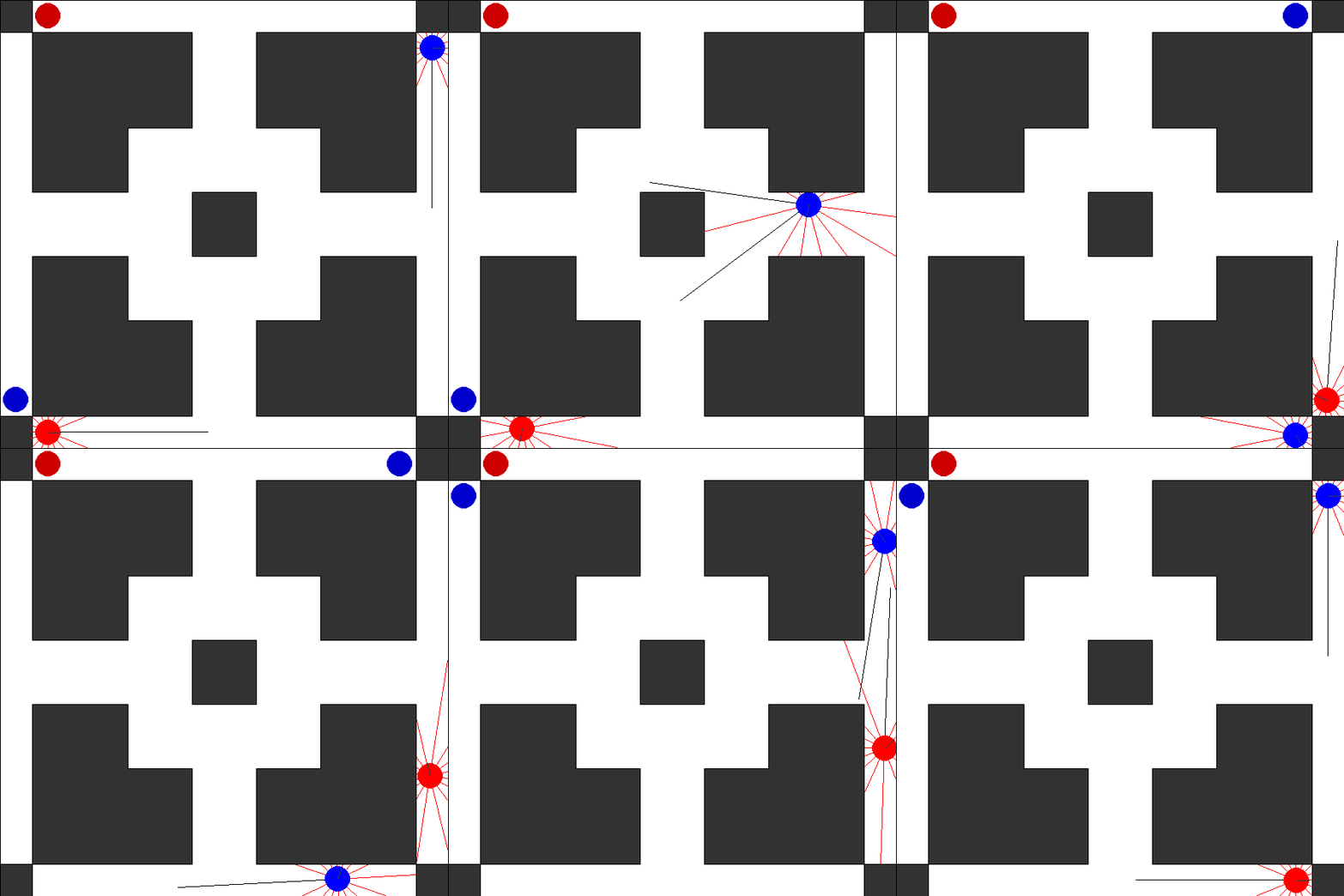
This environment is part of the Continuous environments. Please read that page first for general information.
Possible Agents |
(‘0’, ‘1’) |
Action Spaces |
{‘0’: Box([-0.7853982 -0.25 ], [0.7853982 0.25 ], (2,), float32), ‘1’: Box([-0.7853982 -0.25 ], [0.7853982 0.25 ], (2,), float32)} |
Observation Spaces |
{‘0’: Box([ 0. 0. 0. 0. 0. 0. 0. 0. 0. 0. 0. 0. 0. 0. 0. 0. 0. 0. 0. 0. 0. 0. 0. 0. 0. 0. 0. 0. 0. 0. 0. 0. -6.2831855 -1. -1. 0. 0. ], [ 5. 5. 5. 5. 5. 5. 5. 5. 5. 5. 5. 5. 5. 5. 5. 5. 5. 5. 5. 5. 5. 5. 5. 5. 5. 5. 5. 5. 5. 5. 5. 5. 6.2831855 1. 1. 14. 14. ], (37,), float32), ‘1’: Box([ 0. 0. 0. 0. 0. 0. 0. 0. 0. 0. 0. 0. 0. 0. 0. 0. 0. 0. 0. 0. 0. 0. 0. 0. 0. 0. 0. 0. 0. 0. 0. 0. -6.2831855 -1. -1. 0. 0. ], [ 5. 5. 5. 5. 5. 5. 5. 5. 5. 5. 5. 5. 5. 5. 5. 5. 5. 5. 5. 5. 5. 5. 5. 5. 5. 5. 5. 5. 5. 5. 5. 5. 6.2831855 1. 1. 14. 14. ], (37,), float32)} |
Symmetric |
True |
Import |
|
The Driving Continuous World Environment.
A general-sum 2D continuous world problem involving multiple agents. Each agent controls a vehicle and is tasked with driving the vehicle from it’s start location to a destination location while avoiding crashing into other vehicles. This requires agents to coordinate to avoid collisions and can be used to explore conventions in multi-agent decision-making.
Possible Agents
The environment supports two or more agents, depending on the world layout. It is possible for some agents to finish the episode before other agents by either crashing or reaching their destination, and so not all agents are guaranteed to be active at the same time. All agents will be active at the start of the episode.
State Space
Each state is made up of the state of each vehicle (see VehicleState class),
which in turn is defined by the vehicle’s:
(x, y)coordinates in [0, world_size]direction in [-2π, 2π]
x, y velocity both in [-1, 1]
the angular velocity of the vehicle in [-2π, 2π]
the
(x, y)coordinate of the vehicles destinationwhether the vehicle has reached it’s destination or not:
1or0whether the vehicle has crashed or not:
1or0the minimum distance to the destination achieved by the vehicle in the current episode, if the environment was discrete.
Action Space
Each agent has 2 actions, which are the angular velocity and linear acceleration.
Each agent’s actions is made up of two parts. The first action component specifies
the angular velocity in [-pi/4, pi/4], and the second component specifies the
linear acceleration in [-0.25, 0.25].
Observation Space
Each agent observes a local circle around themselves as a vector. This is achieved by a series of ‘n_sensors’ lines starting at the agent which extend for a distance of ‘obs_dist’. For each line the agent observes the closest entity along the line, specifically if there is a wall or another vehicle. Along with the sensor reading each agent also observes their vehicles angle, velocity (in x, y), and the distance to their destination.
This table enumerates the observation space:
Index: start |
Description |
Values |
|---|---|---|
0 |
Wall distance |
[0, d] |
n_sensors |
Other vehicle distance |
[0, d] |
2 * n_sensors |
Vehicle angle |
[-2π, 2π] |
2 * n_sensors + 1 |
Vehicle x velocity |
[-1, 1] |
2 * n_sensors + 2 |
Vehicle y velocity |
[-1, 1] |
2 * n_sensors + 3 |
distance to destination along x axis |
[0, s] |
2 * n_sensors + 4 |
distance to destination along y axis |
[0, s] |
Where d = obs_dist and s = world.size
If an entity is not observed by a sensor (i.e. it’s not within obs_dist or is not
the closest entity to the observing agent along the line), The distance reading will
be obs_dist.
The sensor reading ordering is relative to the agent’s direction. I.e. the values
for the first sensor at indices 0, n_sensors, correspond to the distance
reading to a wall, and other vehicle, respectively, in the direction the agent is
facing.
Rewards
All agents receive a penalty of 0.0 for each step. They receive a penalty of
-1.0 for crashing (i.e. hitting another vehicle). A reward of 1.0 is given if
the agent reaches it’s destination and a reward of 0.05 is given to the agent at
certain points as it makes progress towards it’s destination (i.e. as it reduces
it’s minimum distance achieved along the shortest path to the destination for the
episode).
Dynamics
Actions are deterministic and movement is determined by direction the vehicle is facing and it’s speed. Vehicles are able to reverse, but cannot change direction while reversing.
Max and min velocity are 1.0 and -1.0, and max linear acceleration is 0.25,
while max angular velocity is π / 4.
Starting State
Each agent is randomly assigned to one of the possible starting locations in the world and one of the possible destination locations, with no two agents starting in the same location or having the same destination location. The possible start and destination locations are determined by the world layout being used.
Episodes End
Episodes end when all agents have either reached their destination or crashed. By
default a max_episode_steps is also set for each DrivingContinuous environment.
The default value is 200 steps, but this may need to be adjusted when using
larger worlds (this can be done by manually specifying a value for
max_episode_steps when creating the environment with posggym.make).
Arguments
world- the world layout to use. This can either be a string specifying one of the supported worlds, or a custom :class:DrivingWorldobject (default ="14x14RoundAbout").num_agents- the number of agents in the environment (default =2).obs_dist- the sensor observation distance, specifying the distance away from itself which an agent can observe along each sensor (default =5.0).n_sensors- the number of sensor lines eminating from the agent. The agent will observe atn_sensorsequidistance intervals over[0, 2*pi](default =16).
Available variants
The DrivingContinuous environment comes with a number of pre-built world layouts
which can be passed as an argument to posggym.make, to create different worlds:
World name |
Max number of agents |
World size |
|---|---|---|
|
6 |
6x6 |
|
4 |
7x7 |
|
6 |
7x7 |
|
4 |
7x7 |
|
4 |
14x14 |
|
8 |
14x14 |
|
4 |
14x14 |
For example to use the DrivingContinuous environment with the 7x7RoundAbout
layout and 2 agents, you would use:
import posggym
env = posggym.make('DrivingContinuous-v0', world="7x7RoundAbout", num_agents=2)
Version History
v0: Initial version
References
Adam Lerer and Alexander Peysakhovich. 2019. Learning Existing Social Conventions via Observationally Augmented Self-Play. In Proceedings of the 2019 AAAI/ACM Conference on AI, Ethics, and Society. 107–114.
Kevin R. McKee, Joel Z. Leibo, Charlie Beattie, and Richard Everett. 2022. Quantifying the Effects of Environment and Population Diversity in Multi-Agent Reinforcement Learning. Autonomous Agents and Multi-Agent Systems 36, 1 (2022), 1–16